Introduction to Recommendation Systems
Introduction to Recommendation Systems
In today's digital age, we are surrounded by an overwhelming amount of content. Netflix has over 17,000 titles, Amazon offers more than 350 million products, YouTube uploads 500+ hours of video every minute, and Spotify hosts 100+ million songs. Without intelligent guidance, users would spend hours searching for something they actually enjoy.
Recommendation systems (also called recommender systems) are the invisible engines that power modern digital experiences. These AI-powered algorithms analyze your past behavior, preferences, and the behavior of millions of similar users to predict exactly what you will love next — often before you even know it yourself.
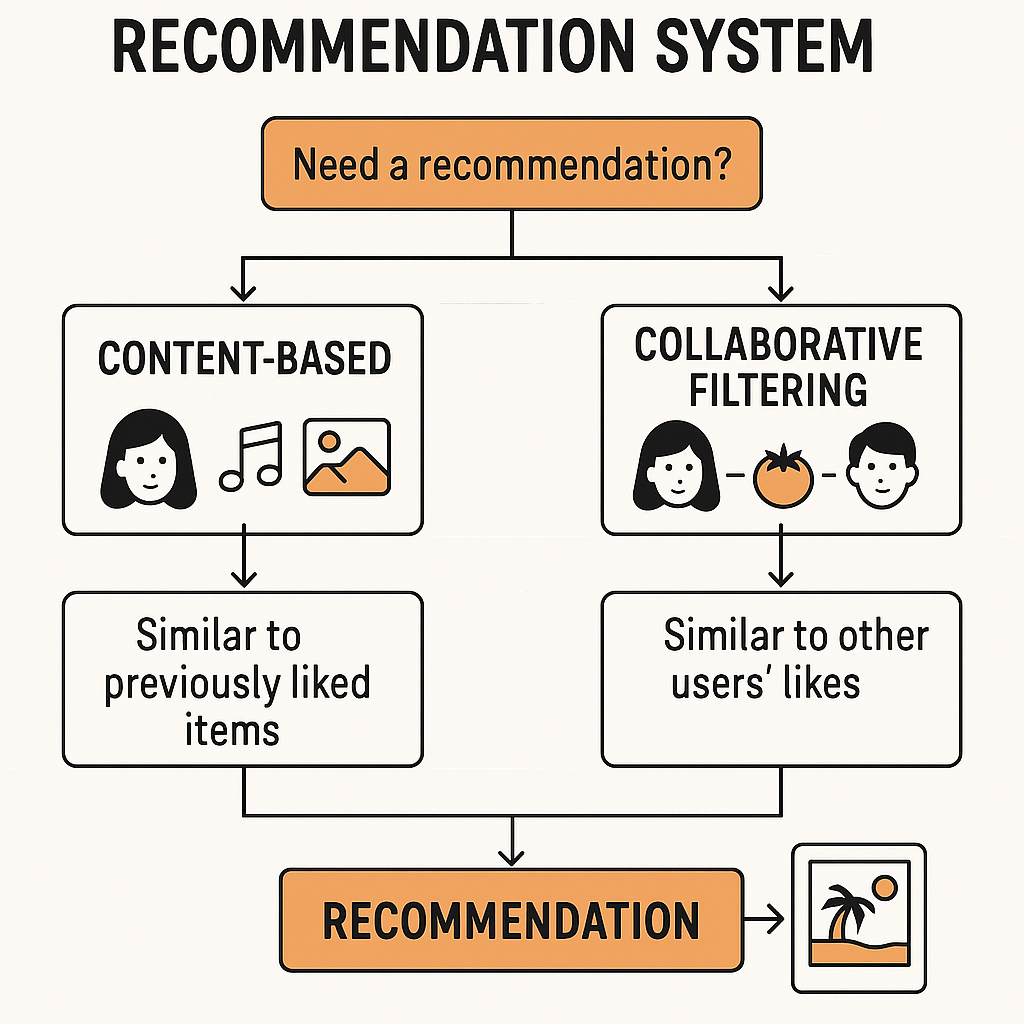
Classic visualization of how recommendation systems connect users and items
What Exactly is a Recommendation System?
A recommendation system is a specialized information filtering system that predicts a user’s rating or preference for an item they have not yet interacted with. It combines techniques from machine learning, statistics, data mining, and even deep learning to deliver hyper-personalized suggestions.
At their core, these systems solve two fundamental problems:
- Information overload — helping users discover relevant items from millions of options.
- Personalization at scale — delivering unique experiences to every single user simultaneously.
Why Recommendation Systems Matter More Than Ever
1. Delivering Truly Personalized Experiences
Instead of a generic homepage, every user sees a completely different interface tailored to their unique taste. This level of personalization increases satisfaction and loyalty dramatically.
2. Conquering Information Overload
Humans cannot manually browse billions of items. Recommendation engines act as smart curators, filtering noise and surfacing hidden gems.
3. Skyrocketing User Engagement & Retention
Platforms using advanced recommenders see users spending 2–3× more time. Netflix claims 80% of watched content comes from recommendations.
4. Massive Business Impact
• Amazon: ~35% of total revenue comes from its recommendation engine.
• Netflix: Saves ~$1 billion annually by reducing churn through better recommendations.
• Spotify: Discover Weekly drives millions of new streams every week.
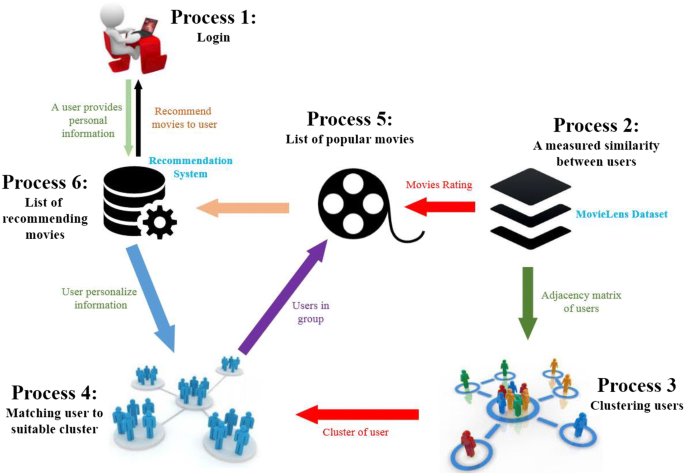
High-level architecture of a modern recommendation pipeline
Real-World Applications That Shape Our Daily Lives
E-Commerce (Amazon, Flipkart, Shopify)
“Customers who bought this also bought…” and “Inspired by your recent views” sections drive massive additional sales.
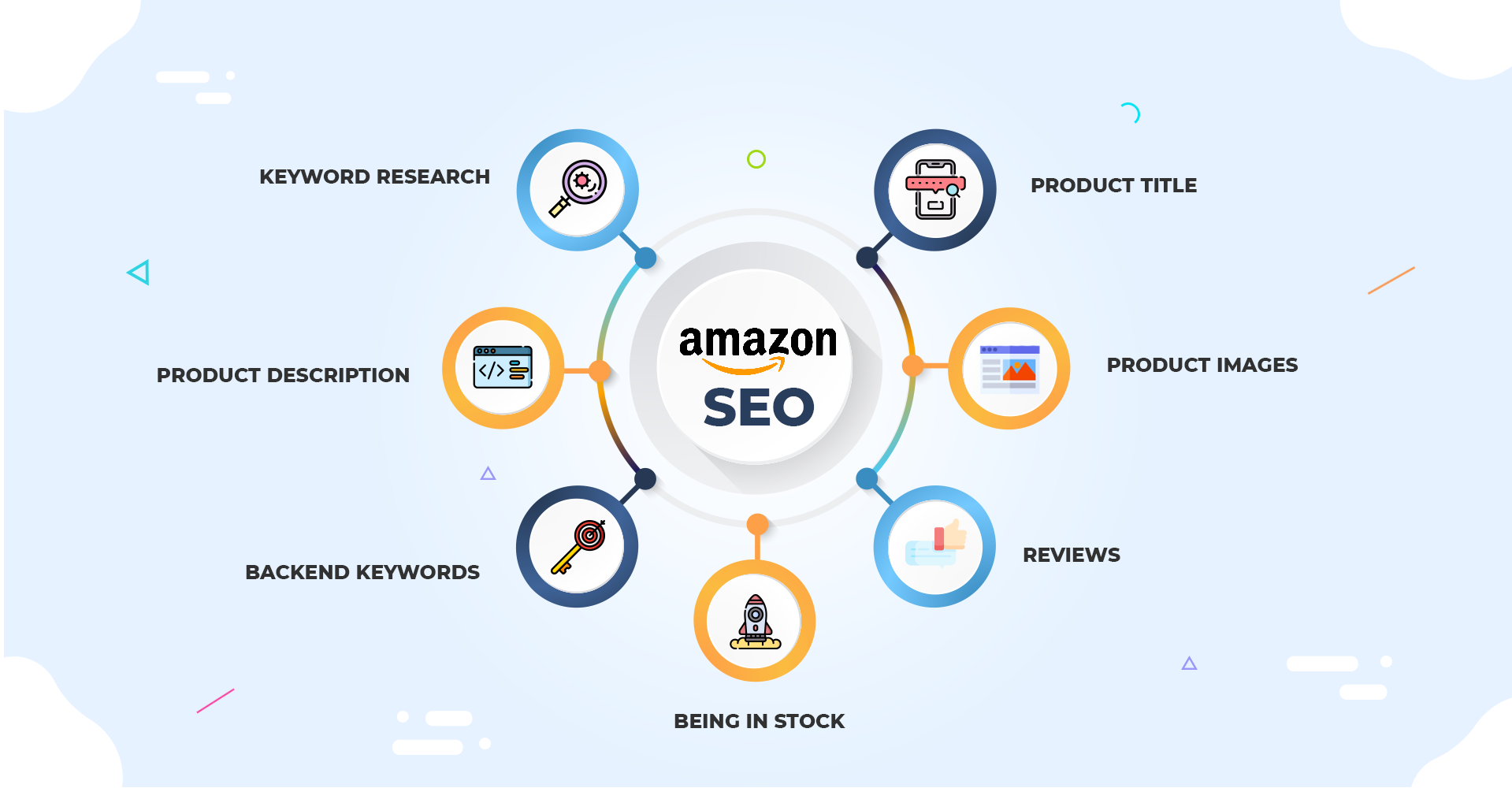
Amazon's famous "You might also like" and personalized product rows
Streaming Entertainment (Netflix, Prime Video, Disney+)
Netflix uses over 1,600 micro-genres and sophisticated deep learning models to create personalized rows like “Top Picks for You” and “Because you watched Stranger Things”.

Netflix homepage with multiple personalized recommendation rows
Music Streaming (Spotify, Apple Music, YouTube Music)
Spotify’s Discover Weekly and Daily Mixes have become cultural phenomena — many users say it knows their music taste better than their friends do.

Spotify's iconic Discover Weekly — a fresh personalized playlist every Monday
Video Platforms (YouTube, TikTok, Instagram Reels)
YouTube’s recommendation algorithm is so powerful that it is estimated to drive over 70% of total watch time.
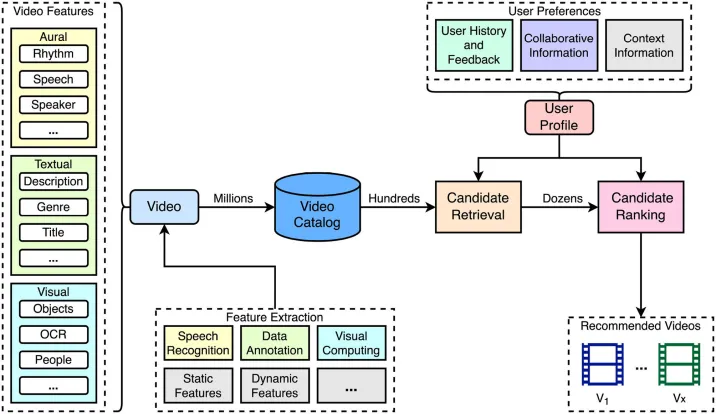
YouTube's personalized video recommendations and "Up Next" sidebar
Other Domains
- Social Media: Friend suggestions, content feed ranking (Facebook, LinkedIn, Twitter/X)
- News: Personalized news feeds (Google News, Apple News)
- Job Portals: Recommended jobs on LinkedIn and Indeed
- Travel: Hotel and flight recommendations on Booking.com and Airbnb
How Do Recommendation Systems Actually Work?
Modern recommenders follow a multi-stage pipeline:
Raw User & Item Data
        ↓
Data Cleaning & Feature Engineering
        ↓
Candidate Generation (Millions → Thousands)
        ↓
Ranking Model (Deep Learning / ML)
        ↓
Re-ranking & Business Rules
        ↓
Final Personalized Suggestions
The Three Main Types of Recommendation Approaches
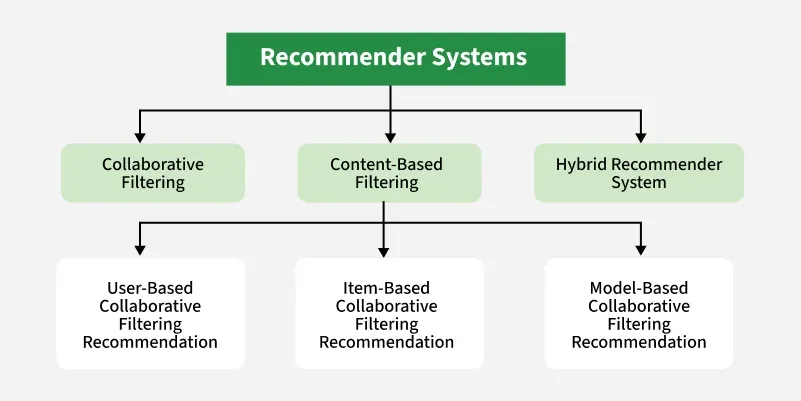
Comparison: Collaborative Filtering vs Content-Based vs Hybrid Systems
1. Collaborative Filtering (Most Popular)
“Users who are similar to you also liked these items.” Works purely on user-item interaction data (ratings, clicks, purchases). No need to know item content.
- User-based: Find similar users
- Item-based: Find similar items
- Matrix Factorization (SVD, NMF) — the technique behind Netflix Prize winner
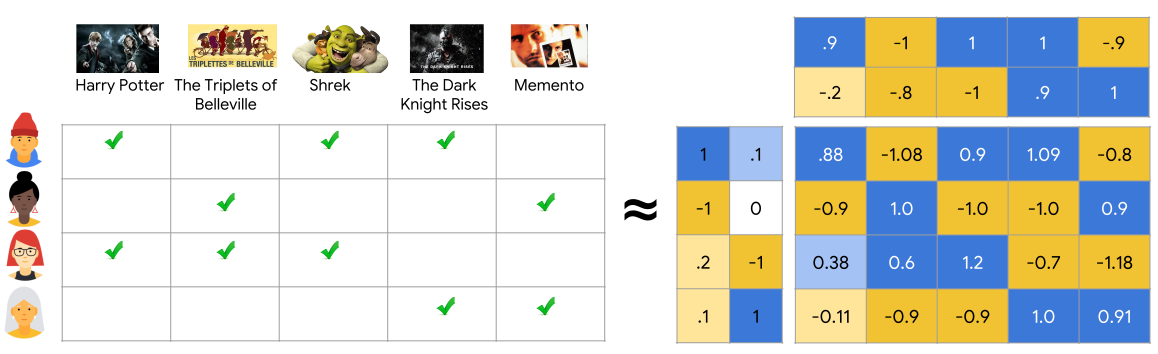
How Matrix Factorization decomposes the user-item rating matrix into latent factors
2. Content-Based Filtering
Recommends items similar to ones the user has liked in the past, based on item features (genre, director, keywords, TF-IDF, embeddings).
Advantage: Works even for new users/items (solves cold-start partially).
3. Hybrid Recommendation Systems
Combine collaborative + content-based (and sometimes knowledge-based or demographic) approaches. Almost all big companies today use hybrid models because they deliver the best accuracy and coverage.
Advanced Techniques Powering Today's Systems
- Deep Learning: Neural Collaborative Filtering, Wide & Deep, Transformers
- Two-Tower Models (used by YouTube & Pinterest)
- Graph Neural Networks for capturing complex relationships
- Contextual & Sequential Recommendations (what you watched in the last 30 minutes matters)
- Multi-objective optimization (balance relevance, diversity, novelty, freshness)
Challenges & Ethical Considerations
While incredibly powerful, recommendation systems face issues like:
- Cold-start problem (new users/items)
- Filter bubbles & echo chambers
- Bias amplification
- Privacy concerns
- Manipulation & adversarial attacks
Responsible AI practices and transparency are becoming increasingly important.
Conclusion
Recommendation systems have evolved from simple “people who bought X also bought Y” rules into sophisticated AI engines that deeply understand human preferences at planetary scale. They are now one of the most impactful applications of machine learning in the world — quietly shaping what we watch, buy, listen to, and discover every single day.
In the next article in this series, we will dive deep into Building Your First Recommendation System with code examples (collaborative filtering using Python, Surprise library, and matrix factorization), followed by advanced deep learning approaches.
Stay tuned — the future of personalization is just getting started!


Comments
Post a Comment