Types of Recommendation Systems
Types of Recommendation Systems: A Complete Guide
Recommendation systems are the backbone of modern digital platforms. Whether you’re scrolling Netflix, shopping on Amazon, or discovering new music on Spotify, these intelligent algorithms decide what you see next.
There is no single “best” technique. Each type of recommender has its own strengths, weaknesses, and ideal use cases. In this comprehensive guide, we’ll explore all major types of recommendation systems with real-world examples, mathematical intuition, advantages, limitations, and how top companies actually combine them.
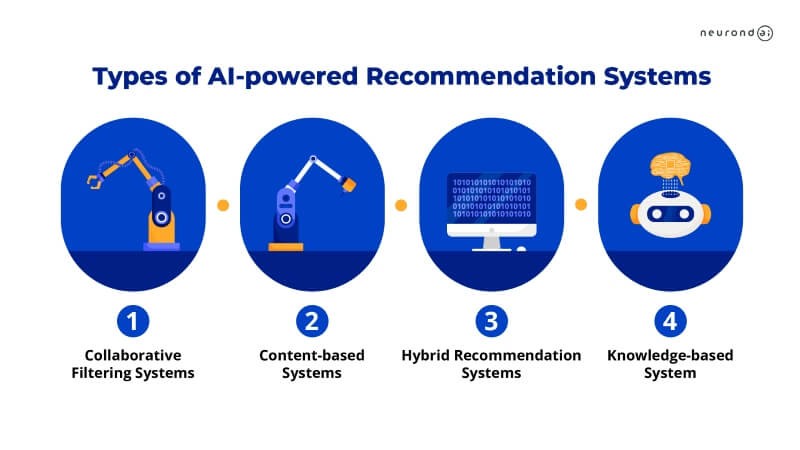
Visual overview of the major types of recommendation systems used in industry today
1. Collaborative Filtering (The Most Popular Approach)
Collaborative Filtering is based on the simple but powerful idea: “Users who agreed in the past will agree in the future.” It relies purely on user-item interaction data (ratings, clicks, purchases, watch time) — no item descriptions needed.
Two Main Sub-Types
A. User-Based Collaborative Filtering
Finds users with similar tastes to you and recommends items they liked but you haven’t tried yet.
Example: If User A and User B both loved Inception and Interstellar, and User B also loved Dune, then Dune will be recommended to User A.
B. Item-Based Collaborative Filtering
More stable and scalable. It finds items that are similar to ones you already liked.
Example: If many users who bought a wireless mouse also bought a mechanical keyboard, the system recommends the keyboard to anyone who bought the mouse.
Advanced Technique: Matrix Factorization
The breakthrough method that won the $1M Netflix Prize. It decomposes the huge user-item rating matrix into two smaller matrices (user factors × item factors) to discover hidden “latent” features.
Rating Matrix (Users × Items) ≈ User Latent Factors × Item Latent Factors
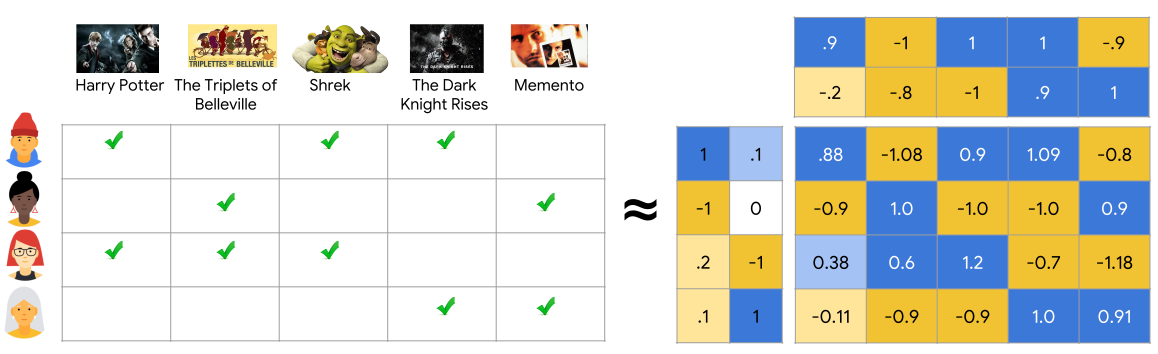
How Matrix Factorization uncovers hidden patterns in sparse rating data
Pros & Cons of Collaborative Filtering
- Pros: Highly accurate, discovers unexpected connections, no need for item metadata
- Cons: Cold-start problem (new users/items), data sparsity, popularity bias, scalability issues with millions of users
2. Content-Based Filtering
This approach recommends items similar to the ones the user has liked in the past, but based on the actual features/attributes of the items — not other users’ behavior.
How It Works
- Each item is represented by a rich feature vector (genre, director, actors, keywords, TF-IDF, BERT embeddings, etc.)
- A user profile is built by averaging the features of items they liked
- Similarity is calculated using cosine similarity, Euclidean distance, or neural networks
Real-World Examples
Spotify: Analyzes audio features (danceability, energy, valence, tempo) + lyrics + genre to recommend similar songs.
IMDb / Letterboxd: Recommends movies with same director, actors, or plot keywords.

Content-Based Filtering pipeline — item features → user profile → similarity matching
Pros & Cons
- Pros: Solves new-item cold-start, explains recommendations easily (“Because you watched sci-fi”), works with very few users
- Cons: Limited serendipity (only recommends similar items), needs rich item metadata, overspecialization problem
3. Hybrid Recommendation Systems (What Top Companies Actually Use)
Hybrid systems combine two or more techniques to overcome individual weaknesses and achieve superior performance.
Most Common Hybrid Strategies
- Weighted Hybrid — Combine scores from collaborative and content-based (e.g., 0.6×CF + 0.4×CBF)
- Switching Hybrid — Use collaborative for mature users, content-based for new users
- Feature Combination — Merge user behavior and item features into one model
- Cascade Hybrid — Use one method to generate candidates, another to rank them
- Meta-Level Hybrid — One model’s output becomes input features for the next model
Real-World Hybrid Powerhouses
| Company | Hybrid Approach Used | Result |
|---|---|---|
| Netflix | Deep Learning + Collaborative + Content | 80% of views from recommendations |
| Amazon | Item-to-Item + Content + Purchase history | 35%+ of revenue |
| Spotify | Audio features (content) + Collaborative + Listening context | Discover Weekly = cultural phenomenon |
| YouTube | Two-Tower Deep Neural Network (candidate generation + ranking) | 70%+ of watch time |

Modern Hybrid Recommendation System architecture used by Netflix, Amazon & YouTube
4. Other Important Types You Should Know
Knowledge-Based Recommendation
Uses explicit rules and domain knowledge (e.g., “If user wants a laptop under ₹60,000 with 16GB RAM, suggest these 5 models”). Great for domains with few transactions like real estate or cars.
Demographic-Based Recommendation
Recommends based on age, gender, location, income, etc. Simple and useful for cold-start users.
Session/Context-Based (Sequential Recommendation)
Modern approach used by TikTok and YouTube Shorts — predicts next item based on the last 5–10 interactions in the current session using RNNs, Transformers, or BERT4Rec.
Deep Learning & Neural Recommendation Systems (2024–2025 State-of-the-Art)
- Neural Collaborative Filtering (NCF)
- Wide & Deep Learning (Google)
- Transformer-based models (BERT4Rec, SASRec)
- Graph Neural Networks (PinSage by Pinterest)
- Two-Tower Models (YouTube, Facebook)
Detailed Comparison Table
| Technique | Data Required | Cold-Start | Serendipity | Explainability | Scalability | Best Used By |
|---|---|---|---|---|---|---|
| Collaborative Filtering | Only ratings/interactions | Poor | High | Medium | Medium | Netflix, Amazon |
| Content-Based | Item features + user history | Good (new items) | Low | High | High | Spotify, News sites |
| Hybrid | Both | Good | High | High | High | Almost everyone today |
| Knowledge-Based | Rules + domain knowledge | Excellent | Medium | Very High | High | Real estate, Cars |
| Deep Learning Models | Large interaction data | Good with embeddings | Very High | Low | High (with GPUs) | YouTube, TikTok, Spotify |
Conclusion & What’s Next?
Today, almost no production recommendation system uses just one technique. The winners — Netflix, Amazon, YouTube, Spotify — all use sophisticated hybrid + deep learning architectures that combine the best of every world.
Understanding these different types is the foundation for building any real-world recommender. In the next article, we will go hands-on: “Build Your First Recommendation System in Python” using Surprise library, matrix factorization, and then upgrade it to a deep learning hybrid model with PyTorch.
The era of hyper-personalization has only just begun.

Global recommendation systems market is growing at 28%+ CAGR — expected to reach $15+ billion by 2028


Comments
Post a Comment